
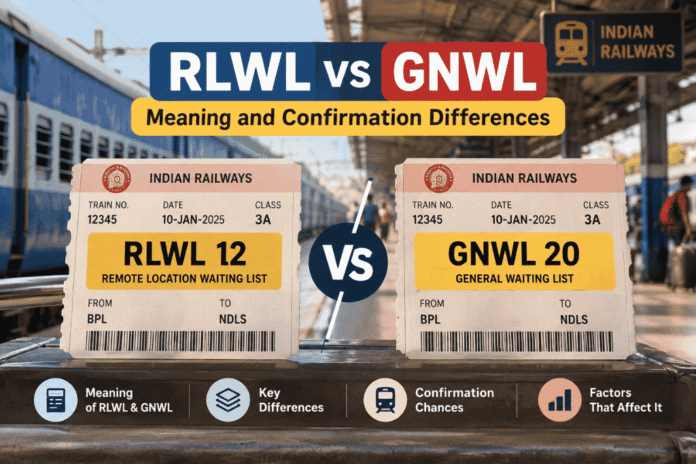
Booking a train ticket in India can sometimes feel like a guessing game, especially when your reservation shows a waiting list status. Two commonly encountered codes are RLWL and GNWL. Although both indicate that your ticket is waitlisted, they represent different reservation quotas and can behave differently when seats become available.
Understanding RLWL vs GNWL can help you make better booking decisions, interpret your ticket status and prepare alternative travel arrangements when necessary.
But does GNWL always have a better chance of confirmation than RLWL? Not necessarily. The outcome depends on several factors, including the train, route, quota availability, cancellations and reservation patterns.
This guide explains the differences between RLWL and GNWL, how their waiting lists operate and what travelers should know before relying on a waitlisted ticket.
What Is RLWL in Indian Railways?
RLWL stands for Remote Location Waiting List. It is associated with reservation quotas allocated to designated intermediate stations along a train’s route.
For example, imagine a train traveling from Mumbai to Delhi with several important stops along the way. Certain intermediate stations may have their own reservation allocations. Passengers booking journeys associated with these remote-location quotas can receive an RLWL status when the relevant accommodation is unavailable.
RLWL confirmation depends on how vacancies become available and are allocated under the applicable reservation rules.
An RLWL ticket does not automatically mean that your chances of confirmation are poor. However, the number of seats allocated to the relevant quota and the pattern of cancellations can affect how the waiting list moves.
For a more detailed explanation of remote-location quotas and their impact on reservations, read our guide on what is RLWL.
What Is GNWL in Indian Railways?
GNWL stands for General Waiting List. It is associated with the general reservation quota, commonly used for journeys originating at a train’s starting station or certain other eligible stations.
When accommodation under the applicable general quota is unavailable, passengers may receive a GNWL status.
For instance, if a train originates in Mumbai and its general quota for a particular journey is fully booked, a passenger may receive GNWL 15. This indicates a waiting-list position rather than a confirmed seat or berth.
GNWL is often considered more favorable because the general quota may have a larger allocation on many services. However, this is not a universal rule.
A GNWL ticket can remain waitlisted even when an RLWL ticket on another journey gets confirmed.
RLWL vs GNWL: Key Differences
The main difference between RLWL and GNWL lies in the reservation quotas they represent and the way vacancies are allocated.
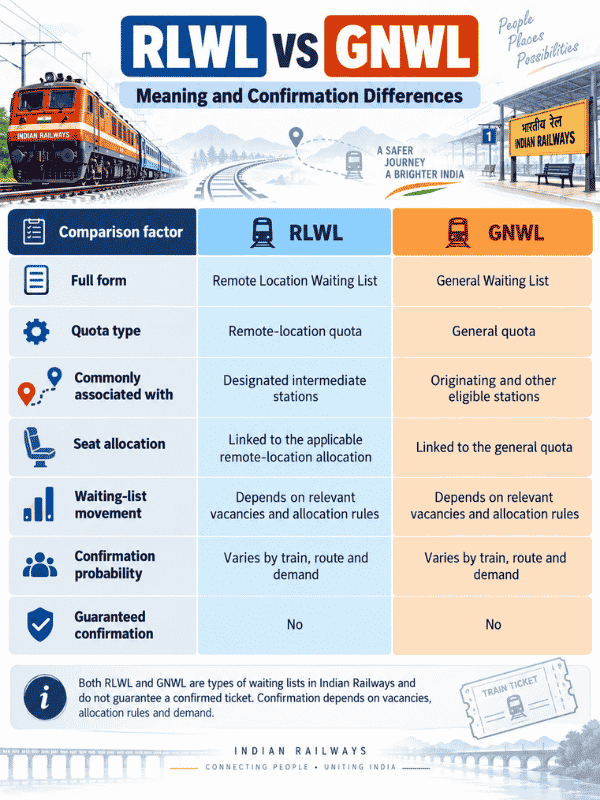
When comparing RLWL vs GNWL, remember that neither code independently determines whether your ticket will be confirmed.
The reservation quota is only one part of the overall picture.
RLWL vs GNWL: Which Has Better Confirmation Chances?
According to Indian Railways passenger traffic statistics, the railway network carried approximately 741 crore passengers during the 2025–26 financial year, reflecting a 3.54% increase over the previous year. While these figures highlight the enormous scale of rail travel in India, they do not directly indicate RLWL or GNWL confirmation probabilities. Actual confirmation depends on quota allocation, cancellations and availability for the specific journey.
One of the most common questions among railway passengers is whether GNWL has better confirmation chances than RLWL.
GNWL may have an advantage on some trains because the general quota can include a larger pool of accommodation. However, it would be misleading to claim that GNWL always receives confirmation priority over RLWL.
Confirmation depends on several factors.
1. Availability Within the Relevant Quota
Different reservation quotas can have different seat allocations. A smaller quota may experience slower waiting-list movement if relatively few vacancies become available.
However, a larger allocation does not guarantee confirmation when demand is exceptionally high.
2. Passenger Cancellations
Cancellations are an important source of vacancies.
If confirmed passengers cancel their tickets, accommodation may become available for eligible waitlisted passengers according to the applicable railway rules.
The effect of a cancellation depends on the journey segments, quota and reservation allocation process.
3. Travel Date and Seasonal Demand
Popular travel periods often experience heavier booking demand.
During Diwali, Christmas, summer holidays and long weekends, both GNWL and RLWL tickets may face significant competition for available accommodation.
Conversely, some trains may experience greater waiting-list movement during less busy periods.
4. Train Route and Journey Segment
Two passengers traveling on the same train may have different waiting-list outcomes because their boarding stations, destinations and applicable quotas differ.
This is why comparing GNWL 20 and RLWL 5 without considering the actual journeys can be misleading.
5. Reservation Chart Preparation
The final reservation chart reflects the accommodation allocated after the applicable reservation processing.
Waiting-list movement can continue before chart preparation, but confirmation should never be assumed simply because a ticket’s position has improved.
Is RLWL 5 Better Than GNWL 20?
Consider two passengers booking different journeys.
- Passenger A receives RLWL 5.
- Passenger B receives GNWL 20.
At first glance, RLWL 5 appears more promising because the waiting-list number is smaller.
However, these numbers belong to different waiting lists and cannot be compared directly.
RLWL 5 might be associated with a small quota where cancellations are uncommon. GNWL 20 might belong to a larger allocation with more frequent cancellations.
Alternatively, RLWL 5 could clear while GNWL 20 remains waitlisted.
The important takeaway: A lower RLWL number does not automatically have better confirmation chances than a higher GNWL number, and vice versa.
Historical trends can provide useful context, but they cannot guarantee the outcome of an individual booking.
How to Check RLWL and GNWL Ticket Status
Once you have booked a waitlisted ticket, monitoring its status helps you understand whether the reservation is progressing toward confirmation.
You can check the latest status through the official IRCTC platform or Indian Railways’ authorized PNR enquiry services.
Your Passenger Name Record (PNR) is a unique 10-digit number associated with your railway reservation.
The enquiry generally displays information such as booking status, current status, train details and journey information.
For a detailed explanation of these codes, see our guide on PNR status meaning.
Understanding Booking Status and Current Status
Suppose your reservation initially displays:
Booking Status: GNWL 25
Later, your current status changes to:
Current Status: GNWL 8
This means your waiting-list position has improved, but your reservation is still not confirmed.
If the status changes to CNF, your reservation is confirmed. RAC indicates Reservation Against Cancellation, under which eligible passengers can travel with accommodation provided according to railway rules.
Checking both booking and current status is more useful than relying only on the original waiting-list number.
Can RLWL and GNWL Tickets Get Confirmed After Chart Preparation?
The preparation of reservation charts is an important milestone for passengers holding waitlisted tickets.
A ticket’s treatment after chart preparation depends on its final status and whether it was booked electronically or through a railway reservation counter.
For a fully waitlisted IRCTC e-ticket, if every passenger remains waitlisted after chart preparation, the booking is dropped from the chart and the passengers are not permitted to board using that ticket. Refunds are processed according to the applicable rules.
Counter-booked tickets can have different cancellation and refund procedures.
Passengers should verify their final PNR status and applicable ticket conditions rather than assuming that a waitlisted ticket permits travel.
Practical Tips When Booking RLWL or GNWL Tickets
If your preferred train has limited availability, a few precautions can help you avoid last-minute travel problems.
- Check alternative trains: Another train on the same route may have confirmed accommodation.
- Compare available classes: Sleeper, 3AC and other classes can have different availability.
- Monitor your PNR: Review changes in your waiting-list position before departure.
- Consider alternative travel dates: Shifting your journey may improve availability.
- Keep a backup plan: Avoid depending entirely on an uncertain waiting-list confirmation.
These steps are especially useful when traveling for important events, connecting journeys or time-sensitive commitments.
Common Misconceptions About RLWL vs GNWL
Several assumptions about railway waiting lists can lead to unrealistic expectations.
Myth 1: GNWL always gets confirmed before RLWL.
There is no universal guarantee that a GNWL booking will be confirmed ahead of every RLWL booking. The quotas and applicable allocation rules matter.
Myth 2: RLWL tickets rarely get confirmed.
RLWL tickets can get confirmed when suitable accommodation becomes available. Confirmation likelihood varies across trains and journeys.
Myth 3: A smaller waiting-list number guarantees confirmation.
A low waiting-list position is encouraging, but it is not a promise of accommodation.
Myth 4: Waiting-list prediction tools provide certain results.
Prediction tools generally rely on historical patterns or statistical estimates. Their results should be treated as guidance rather than official confirmation.
What Should You Choose: RLWL or GNWL?
When evaluating RLWL vs GNWL, focus on the actual availability, your journey requirements and the uncertainty involved rather than choosing solely by waiting-list code.
GNWL may offer relatively favorable movement on some routes, while RLWL can also clear depending on vacancies associated with the relevant journey.
If you have flexibility, compare alternative trains, travel dates and accommodation classes before completing your booking.
For journeys that cannot be postponed, a confirmed ticket is generally a safer option than relying on either waiting list.
Understanding the Difference Before You Book
The RLWL vs GNWL comparison is ultimately about understanding how different railway reservation quotas work.
GNWL represents the General Waiting List, while RLWL represents the Remote Location Waiting List. Both indicate that confirmed accommodation has not yet been allocated.
Neither status guarantees confirmation, and neither should be judged solely by its waiting-list number.
By understanding the quota differences, monitoring your PNR and keeping alternative travel options available, you can make more informed decisions and avoid unnecessary uncertainty before your train journey.

