
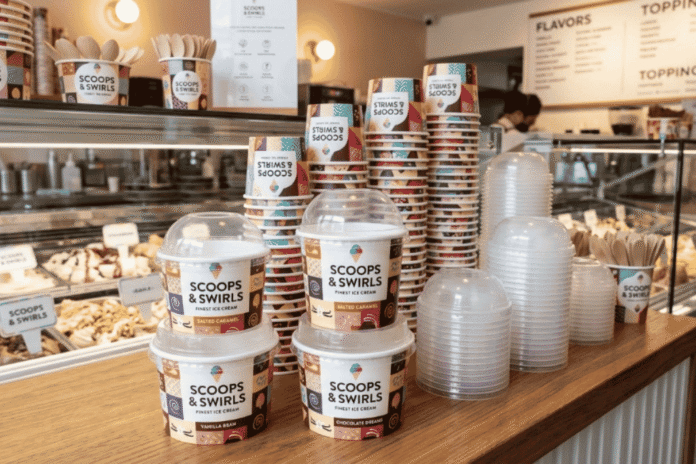
There is something satisfying about picking up a scoop of ice cream on a warm afternoon. The difficult part comes when you want to carry it somewhere else. Perhaps you are walking back to your hotel, taking dessert to the beach, or bringing a takeaway sundae home after dinner. A good serving cup can make that little journey easier. A poorly matched lid can turn it into a mess.
For ice cream parlours, gelato shops, cafés and dessert counters, packaging is part of the experience. Customers may remember the flavour first, but they also notice whether the cup is easy to hold, whether the lid stays on and whether their carefully arranged toppings survive the trip.
Choosing a suitable ice cream cup and lid is not as simple as matching two items of the same stated size. A few practical checks can help businesses avoid common problems before placing a large order.
Why Cup Size Does Not Tell the Whole Story

When buying disposable ice cream cups, capacity is usually the first specification people notice. A shop might offer 4 oz, 8 oz or 12 oz servings, depending on its menu and portion sizes.
However, capacity tells you how much a cup can hold, not whether a particular lid will fit.
Two cups with the same capacity may have different heights, opening diameters and rim shapes. Even cups with the same nominal top diameter can have slightly different edges. Those differences influence how a lid attaches and how securely it stays in place.
This becomes important when a business buys cups from one supplier and lids from another. Both products may look nearly identical in a catalogue, yet the combination may not work properly in everyday use.
Before ordering, check the actual rim dimensions and ask the supplier which lid is designed for that specific cup. Treat the cup and lid as a pair rather than assuming they are interchangeable.
Flat Lids or Dome Lids: Which Works Better?
The answer depends on what goes inside the cup.
Flat lids are often a sensible choice for standard scoops, gelato and pre-portioned ice cream. Their lower profile makes cups easier to stack and can help save space when preparing takeaway orders.
Dome lids are useful when the dessert needs more room above the rim. Think of soft serve, sundaes topped with whipped cream, generous scoops, fruit pieces or a drizzle of chocolate sauce. A little extra height can protect the finished dessert from being pressed against the lid.
There is a practical trade-off, though. Taller lids take up more space in storage bags, delivery boxes and refrigerators. They may also make several filled cups harder to stack.
A shop selling simple scoops throughout the day may have little reason to use dome lids for every order. A dessert counter known for elaborate sundaes may need them regularly.
Rather than choosing one style for everything, look at the actual menu. If two or three lid types cover the needs of the business, that may be more useful than keeping a large collection of packaging that staff rarely use.
What Happens When the Lid Does Not Fit?
A loose lid is an obvious problem. It can shift during handling, come partly undone or fall off when a customer picks up the cup. As ice cream softens, a poorly secured closure can also make spills more likely.
A lid that is too tight creates a different set of difficulties. Staff may have to press unusually hard to close it, potentially deforming the cup rim. In some cases, the lid itself may crack, or customers may struggle to remove it.
Neither extreme is ideal for a busy dessert shop. Staff need to close orders quickly, while customers need to open them without wrestling with the packaging.
Look beyond whether the lid appears to snap into place. Check that it engages around the entire rim, stays attached when the cup is gently tilted and can be removed without damaging the container.
These details matter even more during busy periods, when staff are preparing many orders in succession. A combination that works for one cup but fails on the next is difficult to manage consistently.
Does the Material Make a Difference?
Yes, although the name of the material alone does not guarantee good performance.
Clear PET lids are useful when presentation matters. They allow customers to see colourful toppings, sauces and carefully arranged desserts without removing the lid. This can be particularly appealing for layered sundaes and takeaway treats.
PP lids offer a different balance of flexibility and rigidity, depending on their design and specifications. Paper lids provide an opaque surface and can suit businesses that prefer a less transparent presentation.
The cup matters just as much. Paper and plastic cups can have different rim structures and levels of stiffness. A lid designed for one type should not automatically be used on another, even when the listed diameters look the same.
Businesses should also check whether the selected materials are suitable for their intended food-contact conditions. Relevant product documentation matters, especially when cups will be used for prolonged refrigerated or frozen storage.
There is no single material that is automatically best for every ice cream business. Visibility, appearance, handling, price and disposal arrangements all play a part in the decision.
Test the Cup and Lid Before Buying in Bulk
Ordering samples may seem like an extra step, particularly when a supplier provides clear specifications and product photographs. Still, it is much easier to discover a compatibility problem before hundreds or thousands of units arrive.
A useful test does not need complicated equipment. Start with several samples of the exact cup and matching lid.
First, close each cup using the pressure staff would normally apply. Check whether the lid engages evenly around the rim. Rotate it gently and inspect the edges for loose sections. If it requires excessive force, note that too.
Next, fill the cup with the intended product or a suitable test fill. Close it, carry it and gently tilt it to see whether the lid stays attached. Check for visible deformation and any signs of leakage.
For businesses serving frozen desserts, repeat relevant checks after the filled cup has been stored under the normal refrigerated or frozen conditions. A room-temperature test alone may not reflect the full handling process.
It is also worth testing several samples rather than relying on a single successful attempt. Consistent fit is more useful than one perfect demonstration.
A Few Purchasing Details Worth Confirming
Before approving a large order, ask the supplier to document the specifications of both components. The cup capacity, rim diameter, material, cup height, lid style and matching product codes should be clear.
Also confirm how many cups and lids are included in each carton. They may be sold separately, and different carton quantities can leave a shop with too many cups and not enough lids.
For businesses offering several serving sizes, ask whether any of the cups have been designed and tested to share a lid. A validated shared-lid arrangement can simplify purchasing and storage. It should not be assumed from capacity or diameter alone.
Finally, approve the finished packaging, not just its appearance. Printed artwork may look excellent, but that does not prove that the lid fits properly or that the package performs well during takeaway.
Better Packaging Starts With the Dessert
Ice cream packaging rarely attracts as much attention as the flavours on the menu, but it influences what happens after a customer places an order.
A standard scoop needs a cup that holds its portion comfortably. A tall sundae requires enough room for its toppings. A takeaway order needs a closure that remains secure during normal handling.
The best approach is to start with the dessert, choose a suitable cup shape and lid style, and test the complete combination under realistic conditions. That simple process helps shops reduce avoidable packaging problems and gives customers one less thing to worry about.
After all, when someone buys a gelato while exploring a new city or picks up a sundae after dinner, the packaging should let them enjoy the treat—not become part of the story for the wrong reasons.

