
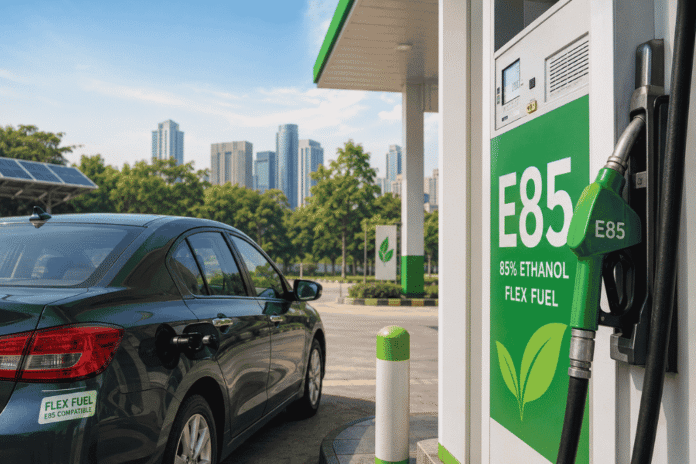
India is preparing to introduce gasoline blended with 85% ethanol, commonly known as E85, as part of its larger push toward cleaner mobility and reduced dependence on imported crude oil.
Oil Minister Hardeep Singh Puri said the new E85 fuel will be priced around ₹20 per litre lower than the currently available E20 petrol. E20, which contains 20% ethanol and 80% petrol, is already sold across India and costs around ₹102 per litre in New Delhi.
The lower price of E85 is linked to its lower calorific value compared to conventional petrol. In simple terms, ethanol contains less energy per litre than petrol, which means vehicles may consume more fuel to cover the same distance. However, the cheaper price point could still make it attractive for owners of compatible vehicles.
What Is E85 Fuel?
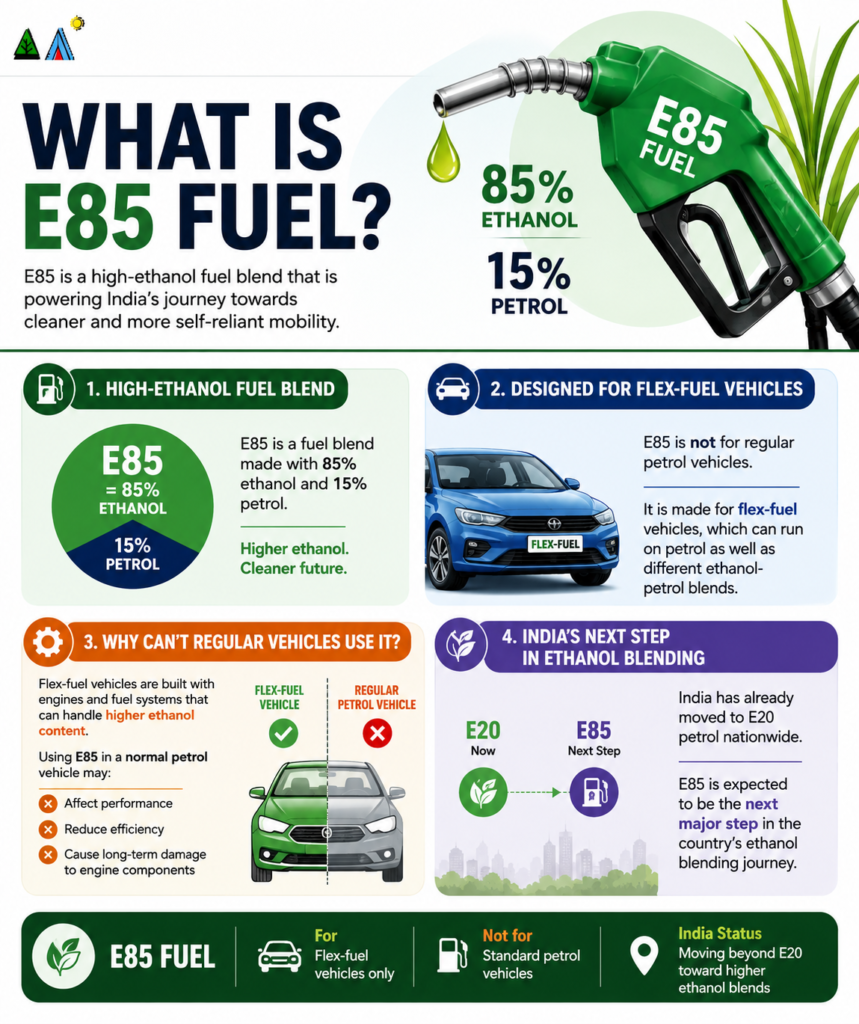
E85 is a high-ethanol fuel blend made up of 85% ethanol and 15% petrol. It is not meant for regular petrol vehicles. Instead, it is designed for flex-fuel vehicles, which can run on petrol as well as different ethanol-petrol blends.
These vehicles are built with engines and fuel systems that can handle higher ethanol content. Without this compatibility, using E85 in a normal petrol vehicle may affect performance and damage components over time.
India has already moved to E20 petrol nationwide, and E85 is expected to be the next step in the country’s ethanol blending journey.
Where Will E85 Be Available First?
The government plans to begin the rollout of E85 fuel at around 50 to 100 fuel stations in 2026. The availability is expected to expand significantly after that, with a target of nearly 5,000 fuel outlets by 2027.
This phased rollout suggests that E85 will initially be available in select cities or regions where flex-fuel vehicles are being introduced or tested. Wider adoption will depend on vehicle availability, consumer acceptance, and ethanol supply.
Automakers Begin Introducing Flex-Fuel Vehicles
Indian automakers have already started preparing for the shift. Companies such as Maruti Suzuki and Hero MotoCorp have introduced flex-fuel compatible versions of popular models, including the WagonR and Splendor.
The support of automakers will be important because E85 can only work at scale if enough compatible vehicles are available in the market. According to Puri, automobile manufacturers and industry bodies are aligned with the government’s plan to introduce the higher ethanol blend.
For consumers, this means future vehicle choices could include more flex-fuel options, especially in two-wheelers and entry-level passenger cars where fuel cost is a major concern.
Why India Is Pushing Ethanol Blending
India is the world’s third-largest oil importer and consumer, making fuel imports a major economic concern. By increasing the share of ethanol in petrol, the country hopes to reduce its dependence on imported crude oil.
Ethanol is largely produced from agricultural sources such as sugarcane, maize, and other biomass. Higher ethanol blending can support domestic agriculture, create demand for biofuel production, and reduce the amount of petrol required in the transport sector.
The government has also linked ethanol blending with lower emissions. Since ethanol is considered a cleaner-burning fuel compared to petrol, wider use of ethanol blends may help reduce certain forms of vehicular pollution.
E85 Comes After India Achieved E20 Blending
India has already achieved its 20% ethanol blending target, a milestone that was originally expected to take longer. After reaching this target, the government began exploring higher blends such as E85 and E100.
In April, India proposed changes to vehicle rules that would allow higher ethanol blends to be used more widely. The E85 rollout is part of that broader direction.
However, the nationwide E20 rollout also brought concerns from vehicle owners. Many motorists questioned whether higher ethanol levels could affect mileage, long-term engine health, and performance, especially in older vehicles.
The government and automakers will likely need to address these concerns clearly as E85 enters the market.
Will E85 Really Be Cheaper for Drivers?
On paper, E85 being around ₹20 per litre cheaper than E20 sounds attractive. But the actual saving for drivers will depend on fuel efficiency.
Because ethanol has lower energy content than petrol, a vehicle running on E85 may deliver lower mileage compared to regular petrol or E20. This means the lower pump price may not always translate into equal savings per kilometre.
For flex-fuel vehicle owners, the real benefit will depend on three things: the price difference between E85 and regular petrol, the mileage difference, and the availability of E85 pumps nearby.
If the price gap remains significant, E85 could become a practical option for daily users, especially in cities where fuel costs are high.
Compressed Biogas Also in Focus
Alongside ethanol blending, the government is also working on a programme to increase compressed biogas production. Oil Secretary Neeraj Mittal said efforts are underway to boost this sector as part of India’s broader alternative fuel strategy.
Compressed biogas can be produced from organic waste, agricultural residue, and other biodegradable materials. Like ethanol, it is seen as a way to reduce fossil fuel dependence while supporting domestic energy production.
What This Means for India’s Fuel Market
The launch of E85 marks an important shift in India’s fuel landscape. For decades, petrol and diesel have dominated the country’s transport energy mix. With E20 already in place and E85 now on the horizon, India is clearly moving toward a more diversified fuel system.
For consumers, the immediate impact may be limited because E85 will only work with flex-fuel vehicles and will first be available at selected fuel stations. But over the next few years, more vehicle models, wider pump availability, and clearer pricing could make high-ethanol fuel a more visible option.
The success of E85 will depend on how well the government, fuel retailers, and automakers manage the transition. Price will attract attention, but long-term trust will come from performance, mileage transparency, and vehicle compatibility.
For now, India’s E85 rollout signals that the country’s fuel market is entering a new phase, one where petrol may no longer be the only default option for millions of drivers.
Got article/news to share? Write for us and have it published under our domain!
Source: CNBC

