
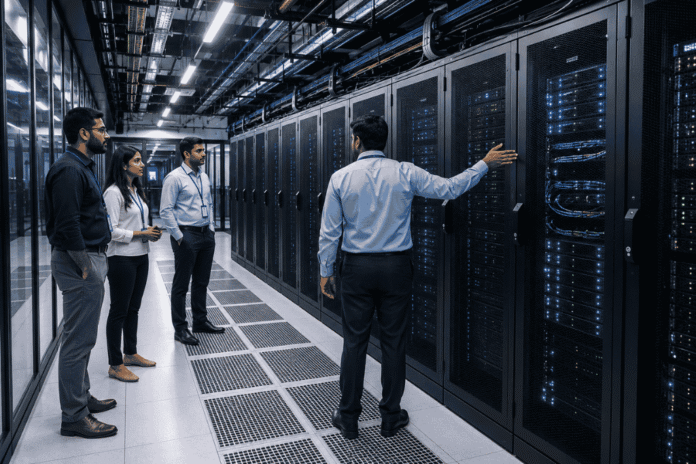
Data centers are becoming one of the most important parts of India’s digital economy. From banking systems and ecommerce platforms to cloud applications, AI workloads, telecom networks, SaaS products, and government services, a large part of modern business depends on infrastructure that most people never get to see directly.
That is why visiting a data center can be a valuable experience. Whether you are an IT leader, business owner, procurement manager, startup founder, compliance professional, or enterprise decision-maker, a physical visit helps you understand what sits behind the services your business depends on.
A data center visit is not only about seeing racks, servers, cables, cooling systems, and security gates. It is about understanding whether the facility can support uptime, security, compliance, business continuity, and future growth. Before choosing a colocation provider, cloud partner, disaster recovery site, or managed hosting provider, an on-site visit can reveal details that brochures and sales presentations may not show.
India’s data center market is also expanding quickly. The growth is being driven by cloud adoption, AI infrastructure, enterprise digitization, data localization needs, and rising demand for colocation services. Major operators are expanding capacity across cities such as Mumbai, Navi Mumbai, Chennai, Hyderabad, Bengaluru, Noida, Pune, Kolkata, Ahmedabad, and Delhi NCR.
Why Visiting a Data Center Matters
Many businesses compare data center providers based on pricing, uptime claims, certifications, location, bandwidth, and rack availability. These are important, but they do not tell the full story.
A physical visit helps you see how the facility actually operates. You can observe how access is controlled, how power backup is managed, how cooling systems are monitored, how security is enforced, and how operational teams handle day-to-day processes.
For businesses running critical applications, this matters a lot. Even a few minutes of downtime can affect customers, transactions, internal teams, and revenue. A visit gives you more confidence that your systems are being hosted in a facility that can support reliability, scalability, and security.
Know the Purpose of Your Visit
Before visiting a data center, be clear about why you are going there. Different visitors may have different priorities.
If you are evaluating colocation, you may want to inspect rack space, power density, connectivity options, security controls, and expansion flexibility. If you are considering a disaster recovery site, your focus may be on location risk, backup power, redundancy, and failover readiness. If you are from a compliance or audit team, you may be more interested in certifications, visitor logs, surveillance, access control, and documented processes.
Having a clear purpose helps you ask better questions. It also helps the data center team arrange the right people to meet you, such as facility managers, network engineers, security officers, compliance representatives, or customer success teams.
Popular Data Centers in India and How to Get There
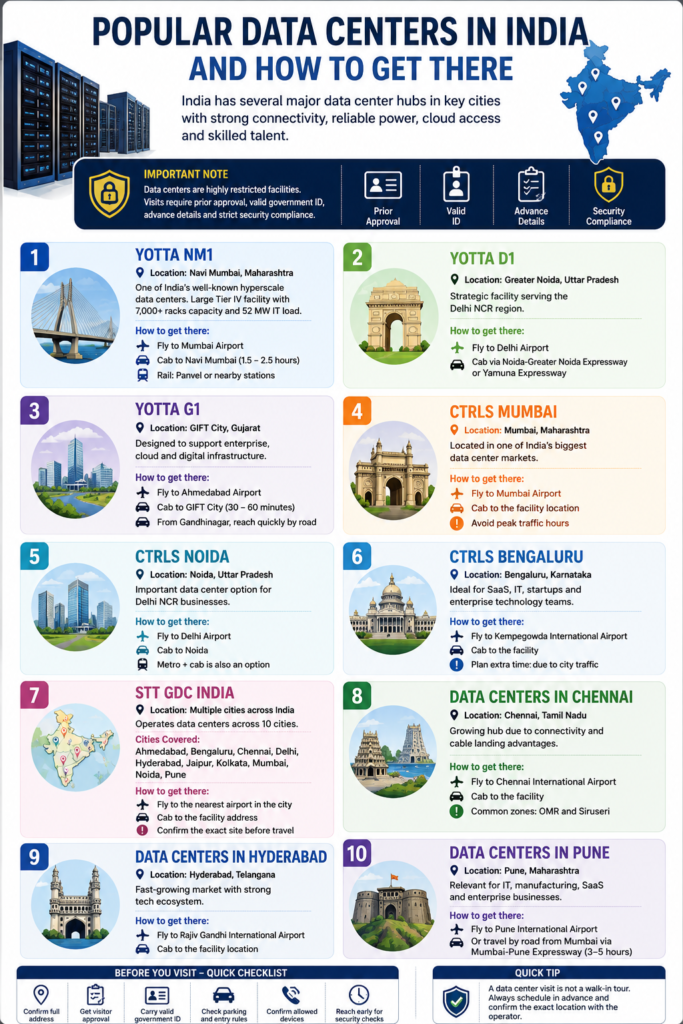
India has several major data center hubs. Most are located in cities with strong enterprise demand, better network connectivity, reliable power infrastructure, cloud access, and availability of skilled technical teams.
Before planning a visit, remember that data centers are highly restricted facilities. You cannot usually walk in directly. A visit must be scheduled in advance with the data center operator, colocation provider, cloud partner, or enterprise account manager. Visitors are normally required to carry a valid government ID, share their details in advance, and follow strict security protocols inside the facility.
Yotta NM1, Navi Mumbai
Yotta NM1 is one of India’s well-known hyperscale data centers, located in Navi Mumbai, Maharashtra. Yotta describes NM1 as a large Tier IV data center with 820,000 sq. ft. of space, 16 floors, 7,000+ racks capacity, and 52 MW IT load. It is part of a larger data center park in Navi Mumbai.
Location: Navi Mumbai, Maharashtra
How to get there: The nearest major airport is Chhatrapati Shivaji Maharaj International Airport, Mumbai. From the airport, visitors can travel by cab toward Navi Mumbai. Depending on traffic, the drive may take around 1.5 to 2.5 hours. If travelling by train, Panvel and other Navi Mumbai railway stations can be considered, followed by a local cab to the approved facility location.
Yotta D1, Greater Noida
Yotta D1 is located in Greater Noida, Uttar Pradesh, and serves the Delhi NCR region. This location is useful for businesses based in Delhi, Noida, Gurugram, Ghaziabad, Faridabad, and other parts of North India.
Location: Greater Noida, Uttar Pradesh
How to get there: Visitors can fly into Indira Gandhi International Airport, Delhi. From there, Greater Noida can be reached by cab through the Noida-Greater Noida Expressway or Yamuna Expressway route. Travel time can vary depending on traffic, so it is better to keep extra buffer time when travelling from Delhi airport.
Yotta G1, GIFT City
Yotta G1 is located in GIFT City, Gujarat. According to Yotta, G1 is located at The Signature Building in GIFT City and is designed to support enterprise, cloud, and digital infrastructure requirements.
Location: GIFT City, Gujarat
How to get there: The nearest major airport is Sardar Vallabhbhai Patel International Airport in Ahmedabad. From the airport, visitors can travel by cab to GIFT City. Depending on traffic, the journey usually takes around 30 to 60 minutes. Visitors coming from Gandhinagar can reach GIFT City more quickly by road.
CtrlS Data Centers, Mumbai
CtrlS operates data centers in Mumbai, one of India’s biggest data center markets. Mumbai is a preferred location because of its strong connectivity, enterprise concentration, financial services ecosystem, and access to subsea cable infrastructure. CtrlS lists Mumbai among its data center locations in India.
Location: Mumbai, Maharashtra
How to get there: Fly into Mumbai airport and travel by cab to the facility address shared by the operator. Since Mumbai traffic can be unpredictable, it is better to schedule visits outside peak business hours where possible. Visitors should confirm the exact facility address in advance because large operators may have multiple locations in and around Mumbai.
CtrlS Data Center, Noida
CtrlS also operates a data center in Noida. Noida is an important data center location for businesses in Delhi NCR because of its connectivity, proximity to enterprise customers, and access to technology corridors.
Location: Noida, Uttar Pradesh
How to get there: The nearest major airport is Indira Gandhi International Airport, Delhi. From the airport, visitors can travel by cab to Noida. The facility is also accessible from Delhi, Gurugram, Ghaziabad, and Greater Noida by road. For visitors using public transport, the Delhi Metro can take you close to Noida, followed by a cab to the approved facility address.
CtrlS Data Center, Bengaluru
Bengaluru is one of India’s largest technology hubs and is important for SaaS companies, IT services, startups, and enterprise technology teams. CtrlS lists Bengaluru among its Indian data center locations.
Location: Bengaluru, Karnataka
How to get there: Visitors can fly into Kempegowda International Airport. From the airport, travel to the facility by cab. Bengaluru traffic can be heavy, so plan extra time. If travelling from within the city, check whether the data center is closer to your office, hotel, or the airport before scheduling the visit.
STT GDC India Data Centers
STT GDC India has one of the largest data center footprints in the country. The company states that it manages data centers across 10 Indian cities, including Ahmedabad, Bengaluru, Chennai, Delhi, Hyderabad, Jaipur, Kolkata, Mumbai, Noida, and Pune.
Location: Multiple cities across India
How to get there: The travel route depends on the selected city and facility. For Mumbai, Chennai, Bengaluru, Hyderabad, Pune, Noida, Delhi, Kolkata, Jaipur, or Ahmedabad, visitors should fly to the nearest major airport and take a cab to the facility address shared by STT GDC or the account manager. Since STT operates multiple facilities, always confirm the exact site before booking travel.
Data Centers in Chennai
Chennai is becoming an important data center hub because of its connectivity, coastal cable landing advantages, power infrastructure, and growing enterprise demand. Several operators have facilities in and around Chennai, including areas near technology corridors such as OMR and Siruseri.
Location: Chennai, Tamil Nadu
How to get there: Fly into Chennai International Airport and travel by cab to the facility. If the data center is located around Siruseri or the OMR technology corridor, travel time from the airport can vary depending on traffic. It is better to plan the visit during non-peak hours.
Data Centers in Hyderabad
Hyderabad is another fast-growing data center location in India. It is attractive because of its technology ecosystem, land availability, enterprise demand, and improving infrastructure.
Location: Hyderabad, Telangana
How to get there: Fly into Rajiv Gandhi International Airport and take a cab to the facility location shared by the operator. Since many technology and industrial zones are spread across the city’s outer regions, confirm the exact travel time before fixing your meeting slot.
Data Centers in Pune
Pune is also part of India’s data center map, especially for businesses in Maharashtra looking beyond Mumbai. It is relevant for IT, automotive, manufacturing, SaaS, and enterprise technology companies.
Location: Pune, Maharashtra
How to get there: Visitors can fly into Pune International Airport or travel by road from Mumbai. If coming from Mumbai, the Mumbai-Pune Expressway is the most common route. Travel time can range from 3 to 5 hours depending on the starting point and traffic.
Check the Location and Risk Factors
Location is one of the first things to evaluate during a data center visit. A good location should offer strong connectivity, reliable power access, manageable environmental risks, and practical accessibility for customers.
However, every city has its own risk profile. A coastal city may have flood or cyclone-related considerations. A dense urban area may face traffic and access challenges. A facility located near industrial zones may need stronger environmental controls. A site in a developing corridor may offer space for expansion but may also depend on improving road and utility infrastructure.
Ask how the provider manages local risks such as flooding, fire, power disruption, heat, water availability, and physical access. Also check whether the facility has enough distance from high-risk zones while still being accessible for authorized customer visits.
Understand Power Infrastructure
Power is one of the most critical parts of any data center. During your visit, pay close attention to how the facility handles power supply, backup, and redundancy.
Ask about the primary power source, backup generators, UPS systems, fuel storage, power distribution units, and maintenance schedules. It is also important to understand whether the facility has redundant power paths. Redundancy helps ensure that if one component fails, another system can continue supporting operations.
Do not just ask whether backup exists. Ask how often it is tested. A backup system that is rarely tested may not perform well during a real outage. You can also ask about historical power incidents and how they were handled.
For businesses running critical applications, power reliability should not be taken lightly. Even a short disruption can affect customer experience, transactions, operations, and revenue.
Look Closely at Cooling Systems
Servers generate heat, and cooling is essential to keep them running safely. A good data center should have a well-designed cooling setup that maintains stable temperature and humidity levels.
During the visit, ask how cooling is managed across the facility. Check whether the data hall has hot aisle and cold aisle arrangements. Ask about temperature monitoring, cooling redundancy, chiller systems, airflow management, and alerts for overheating.
Cooling becomes even more important for high-density workloads, AI infrastructure, GPU-based systems, and large enterprise deployments. If your business expects to scale compute usage over time, the data center should be able to support higher power and cooling requirements.
Poor cooling can shorten hardware life, increase the risk of downtime, and create operational instability.
Evaluate Physical Security
One of the biggest reasons to visit a data center is to evaluate security. A professional facility should have multiple layers of physical security.
Look for perimeter fencing, entry controls, security guards, CCTV coverage, biometric access, visitor verification, mantraps, access cards, and restricted zones. Ask how visitor access is logged and how long records are retained.
You should also ask who can enter the server areas and under what conditions. Access to racks, cages, and customer equipment should be tightly controlled.
For businesses in regulated industries, physical security is not just a best practice. It may be a compliance requirement. A provider should be able to explain its access control process clearly and provide audit records when needed.
Ask About Certifications and Compliance
Certifications help validate the operational and security standards of a data center. During your visit, ask about relevant certifications such as ISO 27001, ISO 9001, ISO 22301, SOC reports, PCI DSS readiness, and other industry-specific requirements.
You can also ask whether the facility follows any data center tier standards or design certifications. However, do not rely only on certification names. Ask what the certification covers, when it was last audited, and whether the documentation can be shared with customers.
Compliance needs may differ based on your industry. A fintech company, healthcare provider, SaaS company, or government vendor may have very different requirements. Before the visit, prepare a list of your compliance expectations and confirm whether the provider can support them.
Review Network Connectivity
Connectivity is another major factor to check. A good data center should offer access to multiple telecom providers, internet service providers, cloud connectivity options, and private network services.
Ask whether the facility is carrier-neutral. A carrier-neutral data center gives you more flexibility because you are not locked into one network provider. This can help with cost, redundancy, performance, and future scaling.
Also ask about cross-connect options, cloud on-ramp availability, latency, bandwidth scalability, and network monitoring. For businesses running applications across multiple regions or cloud platforms, connectivity can directly affect performance.
If your users are mainly in India, the data center’s location and network ecosystem can influence application speed and reliability.
Understand Operational Processes
A data center is not only about infrastructure. It is also about the people and processes that keep it running.
During your visit, ask how incidents are detected, escalated, and resolved. Find out whether the facility operates 24/7 and whether trained engineers are always available on-site. Ask about preventive maintenance, change management, ticketing processes, customer communication, and incident reporting.
You can also ask how the provider handles planned maintenance. A mature provider should have clear processes for notifying customers, reducing risk, and documenting changes.
Operational discipline is often what separates a reliable data center from an average one.
Check Fire Safety and Environmental Controls
Fire safety is another area you should not ignore. Ask about fire detection systems, suppression systems, smoke sensors, emergency exits, and evacuation procedures.
Modern data centers usually use fire suppression methods designed to protect equipment while controlling fire risk. Ask how often these systems are tested and whether emergency drills are conducted.
You should also check environmental monitoring. The facility should track temperature, humidity, water leakage, smoke, and other conditions that can affect equipment safety.
Ask About Scalability
Your current requirements may be small, but your future needs could grow. Before choosing a data center, understand whether the facility can scale with your business.
Ask if additional racks, power, cooling, bandwidth, or private cages can be added later. Also ask how quickly expansion requests can be fulfilled.
Scalability is especially important for fast-growing companies, SaaS providers, ecommerce businesses, AI workloads, and enterprises planning hybrid cloud adoption. Moving infrastructure later can be costly and complex, so it is better to choose a provider that can support future growth.
Prepare the Right Questions Before the Visit
A data center visit becomes more useful when you go prepared. Some important questions to ask include:
What is the facility’s uptime history?
How is power redundancy designed?
How often are backup systems tested?
Which certifications are currently valid?
Who has access to customer equipment?
Is the facility carrier-neutral?
What happens during a power failure?
How are incidents reported to customers?
What physical security layers are in place?
Can the facility support future expansion?
These questions help you move beyond surface-level claims and understand the actual strength of the facility.
Travel Tips Before Visiting a Data Center in India
Always confirm the full address, visitor approval process, parking rules, ID requirements, and allowed devices before the visit. Many data centers restrict photography, laptops, storage devices, and unauthorized equipment inside secure areas.
It is also better to arrive early. Security checks may take time, especially if multiple visitors are attending. Carry a government-issued ID, business card, visitor approval email, and any documents required by the provider.
If the visit is for vendor evaluation, prepare your checklist in advance. Focus on location, power redundancy, cooling, network connectivity, physical security, certifications, support availability, expansion capacity, and incident response process.
What Not to Do During a Data Center Visit
Data centers are highly controlled environments. Visitors should follow all security and safety instructions.
Do not take photos unless permission is clearly given. Do not touch equipment, cables, racks, or access panels. Do not enter restricted zones without approval. Do not bring unnecessary devices into secure areas.
Also, avoid treating the visit like a casual office tour. A data center visit is a serious evaluation of critical infrastructure. Take notes, ask relevant questions, and observe how professionally the visit is managed.
Final Takeaway
Visiting a data center in India can help businesses make better infrastructure decisions. It gives you a closer look at the systems, processes, and people responsible for keeping digital services running.
Before the visit, define your purpose. During the visit, evaluate the location, accessibility, power infrastructure, cooling systems, network connectivity, physical security, compliance standards, operational processes, and future scalability.
A good data center should give you confidence. It should show strong security, reliable infrastructure, clear documentation, operational discipline, and the ability to support your business as it grows.
In a market where digital workloads are increasing rapidly, choosing the right data center is not only an IT decision. It is a business continuity decision.
Got stories to share? Write for us and have it published to a wider audience!

