
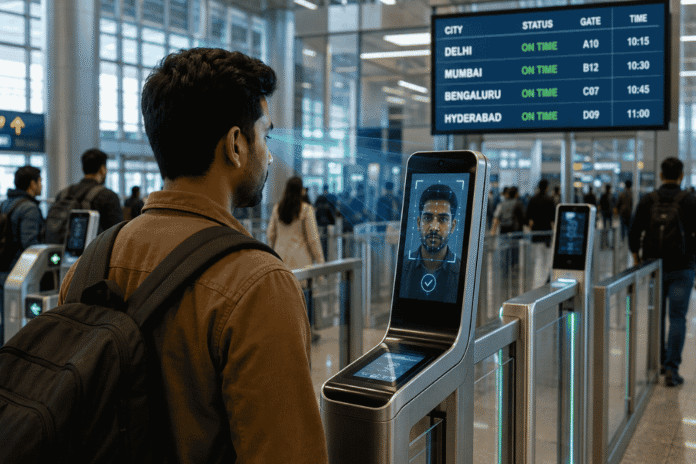
India’s airport travel experience is moving further toward a digital-first model, with DigiYatra biometric transit now made mandatory for international passengers at four major airports: Delhi, Mumbai, Bengaluru, and Hyderabad.
The rollout is part of India’s facial recognition-based passenger processing system, designed to make movement through airports faster, more seamless, and less dependent on repeated document checks. Under this system, a passenger’s face acts as a digital travel token, helping them pass through selected airport checkpoints without scanning their passport or boarding pass multiple times.
What Is DigiYatra Biometric Transit?
DigiYatra is a biometric-enabled airport transit system that uses facial recognition technology to verify passengers at different touchpoints inside the airport. Instead of showing documents again and again, passengers can use biometric e-gates where their face is scanned and matched with the details linked to their travel profile.
The aim is to create a paperless and contactless airport journey. Once the passenger’s identity is authenticated, they can move through airport entry gates and security checkpoints more efficiently.
Which Airports Have Made It Mandatory?
The DigiYatra biometric transit facility has now been implemented for international passengers at these four Indian international airports:
Delhi International Airport
Mumbai International Airport
Bengaluru International Airport
Hyderabad International Airport
These airports are among the busiest aviation hubs in the country, handling a large number of domestic and international travellers every day. The introduction of mandatory biometric transit at these locations is expected to reduce manual checks and improve passenger flow.
How Can International Passengers Use DigiYatra?
To use DigiYatra, passengers need to register through the DigiYatra app. The process generally requires them to upload a selfie, verify their identity using Aadhaar, and link their boarding pass to the app.
Once this is done, the passenger’s biometric template is securely created and stored for verification. At the airport, passengers can approach the DigiYatra-enabled e-gates, where their live facial image is captured and matched with the stored biometric profile.
If the details match, the system allows the passenger to proceed through the checkpoint. This reduces the need for repeated boarding pass scans and manual identity verification at multiple stages inside the airport.
How Does the System Work?
The DigiYatra biometric transit system works by converting a passenger’s face into a secure digital identity. This identity is matched against the passenger’s boarding pass and verified travel details.
At the airport, facial recognition cameras placed at biometric gates scan the passenger’s face. The system then compares the live image with the encrypted biometric template stored in the DigiYatra system. After a successful match, the passenger is allowed to move ahead.
This process is meant to speed up airport movement while maintaining the required security checks. It also helps reduce congestion at document verification points, especially during peak travel hours.
Airlines Supporting the Rollout
Major airlines including IndiGo and Air India have reportedly started supporting the DigiYatra rollout through passenger communication before departure. International carriers such as Emirates and Lufthansa have also informed their ground teams about the implementation of the system at these airports.
This indicates that the system is not only being introduced at the airport level but is also being integrated into airline communication and passenger handling processes.
DigiYatra’s Wider Expansion in India
DigiYatra has already been introduced at several airports across India and has reportedly handled more than 10 crore passenger journeys so far. The system is expected to expand further, with plans to bring 27 more airports under the DigiYatra framework in the coming years.
As India’s aviation sector continues to grow, biometric transit systems like DigiYatra are being positioned as a way to manage higher passenger volumes without slowing down security and boarding processes.
What This Means for International Travellers
For international passengers travelling through Delhi, Mumbai, Bengaluru, and Hyderabad, DigiYatra biometric transit means a more automated airport journey. Once registered, passengers can expect fewer manual document checks at eligible touchpoints and faster movement through biometric gates.
However, passengers should make sure they complete the registration process correctly before reaching the airport. They should also keep their passport, visa, boarding pass, and other travel documents ready, as biometric processing does not remove the need for standard immigration, airline, or security requirements.
DigiYatra is designed to make airport transit smoother, but it works alongside existing travel and security checks rather than replacing them completely.
Got stories to share? Write for us and have it published to a wider audience!

