
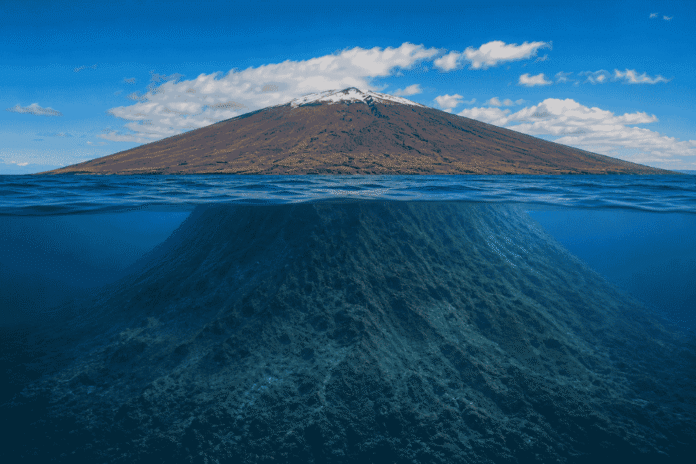
When people think of the tallest mountain in the world, Mount Everest is usually the first name that comes to mind. Standing at 8,848.86 meters above sea level, Everest is known as the highest mountain on Earth. But here is where geography gets interesting. If mountains are measured from their base to their summit, the title of the tallest mountain belongs to Mauna Kea in Hawaii.
Mauna Kea is often described as the mountain in Hawaii taller than Everest, and for good reason. While its summit rises about 4,207 meters above sea level, most of the mountain is hidden below the Pacific Ocean. From its base on the ocean floor to its summit, Mauna Kea stretches far higher than Everest.
This makes Mauna Kea one of the most fascinating natural landmarks in the world. It is not just a mountain. It is a dormant volcano, a sacred Hawaiian site, a world-class astronomy destination, and one of the most unique places to visit on the Big Island of Hawaii.
Where Is Mauna Kea Located?
Mauna Kea is located on the island of Hawaii, commonly called the Big Island. It is one of the five volcanoes that formed the island, along with Mauna Loa, Kilauea, Hualalai, and Kohala.
The name Mauna Kea means “white mountain” in Hawaiian. The name comes from the snow that sometimes covers its summit during winter. This may surprise many travelers because Hawaii is usually associated with beaches, palm trees, warm weather, and tropical landscapes. Yet on Mauna Kea, visitors can sometimes see snow while still being just a few hours away from the ocean.
The mountain dominates the northern part of the Big Island and can be seen from several areas when the weather is clear. Its high elevation, remote location, and dry atmosphere have made it one of the best places on Earth for astronomical observation.
Is Mauna Kea Really Taller Than Mount Everest?
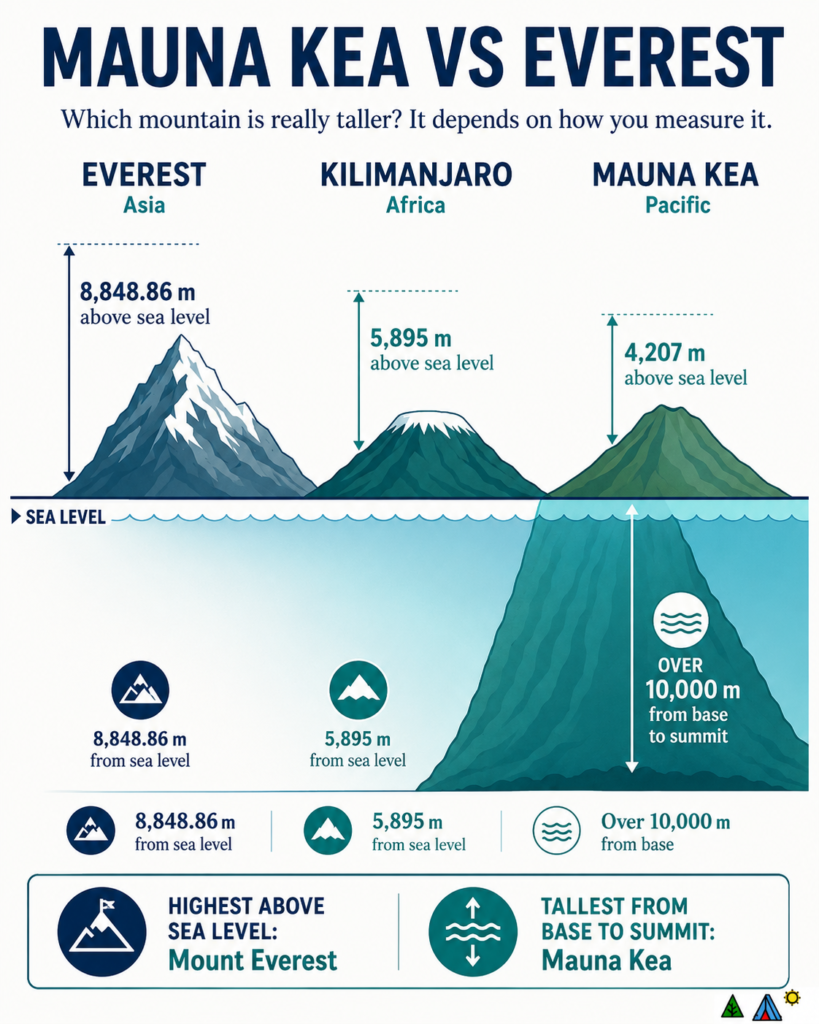
Yes, Mauna Kea is taller than Mount Everest if measured from base to peak.
Mount Everest is the highest mountain in the world when measured from sea level. Its summit reaches 8,848.86 meters above sea level. Mauna Kea, on the other hand, rises only about 4,207 meters above sea level. Based on elevation alone, Everest is much higher.
But Mauna Kea begins deep below the Pacific Ocean. A large portion of the volcano sits underwater, extending thousands of meters down to the ocean floor. When the full height of the mountain is measured from its underwater base to its summit, Mauna Kea is over 10,000 meters tall. That makes it taller than Mount Everest in total height.
This is why the comparison depends on how you define “tallest.”
If you mean the highest point above sea level, Everest wins.
If you mean the tallest mountain from base to summit, Mauna Kea wins.
That is what makes Mauna Kea such a remarkable geographic wonder.
Why Is Everest Still Called the Highest Mountain?
Mount Everest holds the title of the highest mountain because mountain elevations are usually measured from sea level. This is the standard method used in geography, mapping, and mountaineering.
By that measurement, Everest is unmatched. Its summit stands above every other point on Earth’s surface.
Mauna Kea’s summit is much lower above sea level, but its full structure is mostly hidden underwater. Since standard mountain height is usually based on elevation, Everest remains the highest mountain in the world.
However, Mauna Kea gives us another way to understand mountains. It reminds us that what we see above the surface is not always the whole story. Much of Mauna Kea’s true size is invisible to visitors standing on land.
How Was Mauna Kea Formed?
Mauna Kea was formed by volcanic activity over hundreds of thousands of years. Like other Hawaiian volcanoes, it was created as the Pacific tectonic plate moved over a hotspot beneath the Earth’s crust.
This hotspot produced repeated volcanic eruptions that built the mountain layer by layer. Over time, lava flows accumulated and formed the massive shield volcano we now know as Mauna Kea.
Mauna Kea is considered dormant, not extinct. This means it is not currently erupting, but it could erupt again in the future. Its last eruption is believed to have happened thousands of years ago.
Unlike steep, dramatic mountains such as Everest, Mauna Kea has a broad, gentle shape typical of shield volcanoes. Its slopes rise gradually, which makes its enormous size less obvious from a distance. But beneath the ocean, the mountain continues downward for thousands of meters, making it one of the largest mountain structures on Earth.
Why Is Mauna Kea Important to Native Hawaiians?
Mauna Kea is deeply sacred in Native Hawaiian culture. It is considered a place of spiritual importance and is connected to Hawaiian traditions, ancestors, and creation stories.
For many Native Hawaiians, Mauna Kea is not simply a tourist attraction or scientific site. It is a sacred landscape that deserves respect and protection. The summit area is especially significant, and visitors are expected to behave with care.
This cultural importance has also made Mauna Kea a site of debate. The mountain is home to several astronomical observatories, and proposals for additional development have raised concerns among Native Hawaiian groups and environmental advocates. For them, protecting Mauna Kea means preserving both cultural heritage and the natural environment.
Anyone visiting Mauna Kea should understand that the mountain holds meaning far beyond its height. It is a living cultural landscape, and responsible travel starts with respecting that.
Why Is Mauna Kea Famous for Astronomy?
Mauna Kea is one of the world’s top locations for astronomy. Its summit has clear skies, low humidity, high elevation, and very little light pollution. These conditions make it ideal for observing stars, planets, galaxies, and other objects in space.
Several major observatories are located near the summit. Scientists from around the world use these telescopes to study the universe. The mountain’s location in the middle of the Pacific also gives astronomers a unique view of the night sky.
For travelers, this has made Mauna Kea a popular stargazing destination. Even if you do not visit the summit, the Visitor Information Station area offers excellent views of the night sky. On a clear evening, the stars can appear incredibly bright, making it one of the most memorable experiences on the Big Island.
Can Tourists Visit Mauna Kea?
Yes, tourists can visit Mauna Kea, but it requires planning. The mountain’s high elevation can affect visitors, especially those who are not used to altitude. The air is thinner near the summit, and temperatures can be very cold, even in Hawaii.
Many visitors stop at the Mauna Kea Visitor Information Station, located at around 9,200 feet. This is a popular place to rest, learn about the mountain, and enjoy stargazing. It is more accessible than the summit and is often recommended for travelers who want the Mauna Kea experience without going all the way up.
Also check: Best Closest Places to Stay Near Mauna Kea
Reaching the summit usually requires a suitable four-wheel-drive vehicle, and some rental car companies may not allow their vehicles on the summit road. Weather conditions can also change quickly. Snow, ice, fog, and strong winds are possible at higher elevations.
Because of these factors, many travelers choose a guided Mauna Kea tour. These tours often include transportation, warm clothing, sunset viewing, and stargazing.
Best Time to Visit Mauna Kea
Mauna Kea can be visited throughout the year, but the experience depends heavily on weather conditions. Clear nights are best for stargazing, while sunset visits are popular for photography and scenic views.
Winter can bring snow to the summit, which makes the mountain even more unusual for visitors expecting a tropical Hawaiian landscape. However, winter conditions can also make access more difficult.
For stargazing, it is best to avoid nights close to the full moon because moonlight can reduce visibility. A new moon or darker moon phase usually offers better views of the stars.
Visitors should also check road, weather, and safety updates before heading up the mountain. Conditions at sea level can be warm and sunny, while the summit can be freezing and windy.
Things to Know Before Visiting Mauna Kea
Before visiting Mauna Kea, it is important to prepare properly. The altitude can cause headaches, dizziness, or shortness of breath for some people. Spending time at the Visitor Information Station before going higher can help the body adjust.
Warm clothing is essential. Temperatures near the summit can drop sharply, especially after sunset. A jacket, gloves, and closed shoes are recommended.
Visitors should also avoid rushing. Mauna Kea is not a place to treat like a quick roadside stop. The mountain deserves time, respect, and awareness. Stay on marked roads and trails, follow local rules, and avoid disturbing cultural or natural sites.
It is also important to remember that the summit is sacred. Travelers should behave respectfully, avoid loud behavior, and follow all posted guidance.
Mauna Kea vs Mauna Loa: What Is the Difference?
Mauna Kea and Mauna Loa are both massive volcanoes on the Big Island, but they are different in several ways.
Mauna Kea is the tallest mountain in Hawaii and the tallest mountain on Earth when measured from base to summit. Mauna Loa, however, is considered the largest active volcano on Earth by volume and area.
Mauna Loa has erupted more recently and is still one of the most closely monitored volcanoes in the world. Mauna Kea is dormant and much older in its volcanic life cycle.
For travelers, Mauna Kea is most famous for stargazing, observatories, cultural significance, and its unusual height comparison with Everest. Mauna Loa is known more for its massive scale, volcanic activity, and connection to Hawaii Volcanoes National Park.
Why Mauna Kea Should Be on Your Hawaii Travel List
Mauna Kea is one of the most extraordinary places in Hawaii. It offers something very different from the beaches and waterfalls that many travelers expect. A visit here can take you from tropical coastlines to alpine-like landscapes in the same day.
The mountain gives travelers a chance to see Hawaii from a new perspective. You can watch the sunset above the clouds, look across volcanic landscapes, and experience some of the clearest night skies on the planet.
But what makes Mauna Kea truly special is its layered identity. It is a natural wonder, a sacred place, a scientific hub, and a geographic record-breaker. The fact that it is a mountain in Hawaii taller than Everest only adds to its appeal.
Mauna Kea’s Place in the World
Mauna Kea challenges the way we think about mountains. Mount Everest may be the highest mountain above sea level, but Mauna Kea is taller when measured from its base on the ocean floor to its summit.
This hidden height makes Mauna Kea one of the most fascinating mountains in the world. Located on Hawaii’s Big Island, it combines geology, culture, science, and travel into one unforgettable destination.
Also read: The First Woman Who Reached the Top of Mount Everest
For visitors, Mauna Kea is not just about reaching a high point. It is about understanding a place that is sacred, powerful, and unlike anywhere else in Hawaii. Whether you visit for stargazing, scenic views, or curiosity about the world’s tallest mountain by total height, Mauna Kea is a destination that leaves a lasting impression.

